The Perfect First Draft Is a Myth
A perfect first draft is a myth. Learn how to separate making from revision, recognize when a draft is ready, and choose a clear next action.
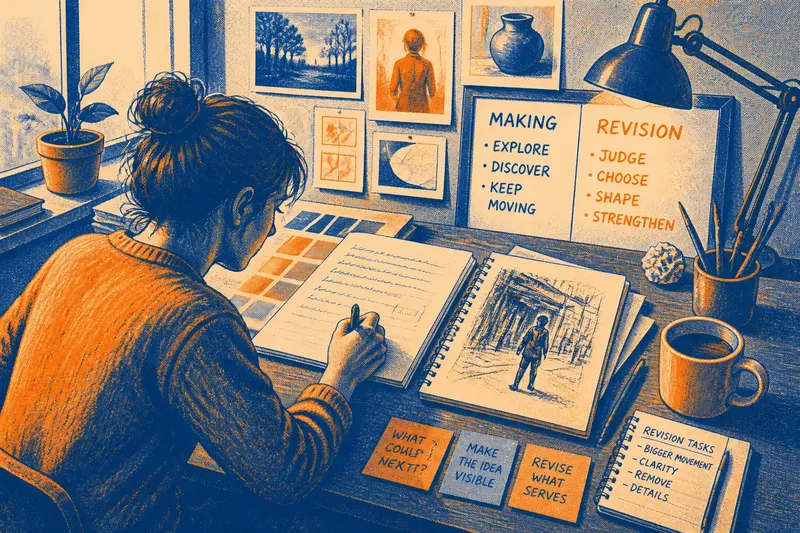
The most common mistake in a first draft is stopping to make every sentence, sketch, or musical phrase presentable. That can cost you the shape of the idea: you polish one small part before you know what the whole piece needs to become.
A perfect first draft is a myth because making and revising ask different questions. Making gives an idea room to take form; revision helps you judge whether its parts belong together. The distinction is not an excuse for careless work. It is a way to give each kind of attention its proper moment.
Why a perfect first draft can stall a creative project
When you try to invent and evaluate at once, each new choice becomes a verdict. You reach for the next sentence, color, or chord, then stop to ask if it is good enough. That judgment can interrupt the chain of decisions that would have shown you where the idea was going.
This is especially frustrating when a project has several plausible directions. A story might begin with a character, a place, or a problem. A ceramic form might start with a curve or a use. Treating every early choice as final can leave you circling the starting point instead of gathering material.
Standards still matter; they simply work better at a stage when there is something to assess. While making, ask what could come next. While revising, ask what serves the piece and what distracts from it.
A first draft should make the idea visible
The first pass is useful when it gives you enough material to respond to. That might be a rough page of prose, a charcoal thumbnail, a voice memo, or fabric swatches arranged on a table. The draft does not have to prove that the final work is already good. It has to show you something you could not see while the idea was only in your head.
Choose a boundary that fits the project: one scene, one loose composition, or one rough pass through a song. When you hit a snag, leave a note such as “[check the room layout]” or “[try a softer transition]” and keep working, unless the missing answer blocks the next meaningful choice.
That exception matters. If a character’s motive determines what happens next, pause to name the motive in plain language. If a detail can wait without changing the direction, mark it and move on. A useful draft keeps its central choices moving without pretending every uncertainty is equally urgent.
Separate making from revision with different tasks
Give each pass a distinct purpose. In a blank Google Docs file, write forward without stopping for spelling suggestions; later, make a copy and read for structure. A painter might make thumbnail sketches on scrap paper before committing to a canvas. A musician might record a rough phone memo, then listen for the phrase that needs shaping.
When the rough work has enough connected parts to show its direction, pause and change tasks. Look at the whole before polishing details: identify the central movement, notice where the work becomes hard to follow, and decide what can be removed. Then turn to local choices such as a repeated word, a shaky contour, or a difficult transition.
Try not to revise everything at once. If the larger structure is still unsettled, tuning a sentence or adjusting a tiny mark may be effort spent on a part that later disappears. Save a copy before major changes so you can compare the evolving piece without treating the earliest version as a standard it must preserve.
How can you tell a draft is ready for revision?
Does a draft need to feel complete before revision?
No. It needs enough connected material to make its direction visible, not a polished ending or a sense of certainty. A fragment may be ready for a focused review, but it cannot answer questions about relationships between parts that have not been made yet.
What is a useful stopping point for a rough draft?
Stop when you can see the main movement of the work, or when the next missing decision genuinely prevents you from continuing. For a scene, that may mean a rough beginning, a turning point, and an ending; for a collage, it may mean the principal shapes are placed well enough to judge their relationship.
Should you revise a single polished fragment?
Only if you are deliberately exploring that fragment in isolation. If the finished piece depends on what comes before or after it, continue making enough surrounding material to judge whether the fragment belongs and what it needs to do.
What should you do when you cannot tell what comes next?
Write the obstacle as a plain question, then answer only what is needed to choose a direction. For example, decide whether a character wants to avoid a conversation or seek one; you do not need to draft the entire scene in your head before continuing.
A worked example shows where making ends and revision begins
Say you are drafting a short scene about a baker closing a shop after a difficult day. Your starting material is a rough opening, a customer returning for a forgotten scarf, and an ending in which the baker turns off the sign. Those are invented details for this example, not a report of a real project.
First, put the three moments in order without polishing their wording. Next, add a rough link showing why the customer’s return matters to the baker. If you cannot decide, write a temporary note: “The baker wants to leave, but chooses to help.” Then read the scene from opening to ending and ask whether that choice changes the final moment.
If the change gives the ending a clear emotional direction, the draft has enough shape for a structural revision; you can strengthen the customer’s return and adjust the ending. If the choice has no effect, try a different link or remove the return from the scene. Either way, the result is a decision about the piece, not a demand to perfect every line before its shape is clear.
Small edits can help, but polishing can also distract
Not every change made during drafting is a detour. Renaming a character may prevent confusing dialogue; shifting a sketch line may make the subject readable enough to continue. The useful question is whether the adjustment enables the next part of the work or mainly makes a small area look finished.
When you catch yourself polishing, mark the concern in a notebook or document margin and return to the unfinished section. If you keep stopping at the same point, treat that as a clue about the work rather than a personal failure. You may need to clarify what the character wants, how a form will be used, or where a musical phrase is headed.
Some work requires accuracy early, particularly when an error could affect safety or consume materials you cannot readily replace. Keep exploration in a lower-risk form, such as a paper mock-up or written plan, and consult relevant instructions or a qualified professional where appropriate.
End the first pass with a clear stopping point
Before you close the file or put away the tools, name what you have actually made and what decision comes next. “The scene reaches the closing sign, but the customer’s return does not yet affect the baker” is more useful than “fix everything.” It identifies a specific revision question without asking you to solve the whole piece at once.
Keep that note beside the draft, and preserve a copy before substantial changes. The next time you return, you can begin with the unresolved decision rather than rereading the work as though it were supposed to arrive finished. That is the practical value of remembering that a perfect first draft is a myth: it lets the first pass provide material, while revision decides what that material can become.