From Apprenticeship to the Practice Room
From apprenticeship to the practice room, explore how shared work, demonstrations, and guided attempts help learners choose a setting that fits a skill.
The common mistake in learning a craft is to assume there is one proper arrangement: an apprentice beside a master, or a learner alone in a practice room. That assumption can steer people away from useful options, such as a community workshop, a class, or a short demonstration followed by feedback.
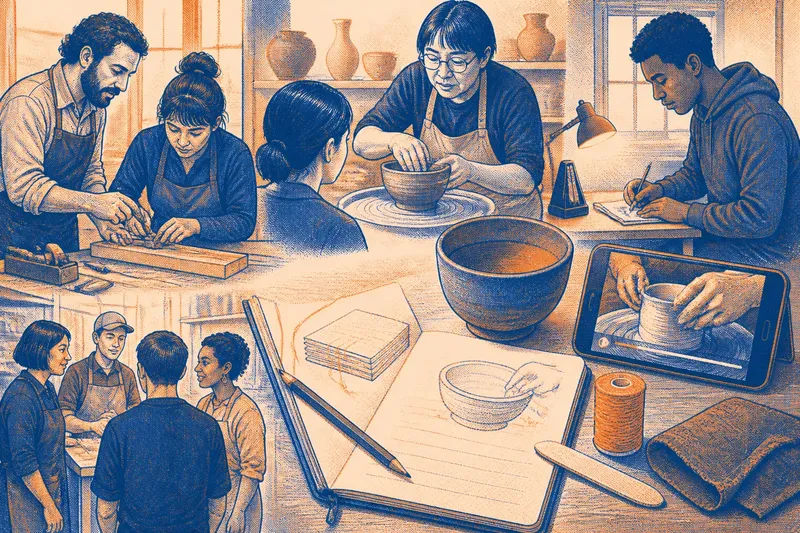
From apprenticeship to the practice room, different settings offer different kinds of contact with a skill. Think of the patterns below as a conceptual map, not a single historical timeline: people learn through shared tasks, observation, guided responsibility, organized communities, focused practice, and combinations of these approaches.
Shared work makes decisions visible
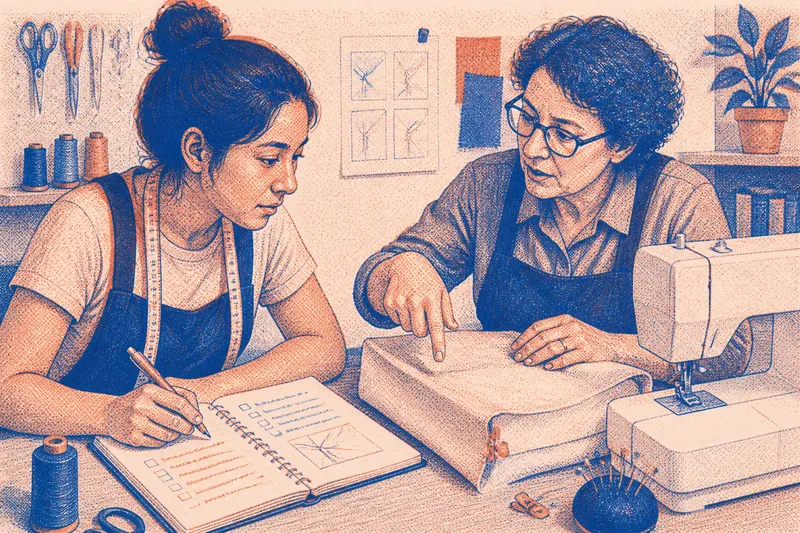
When a learner works near someone experienced, the task itself provides context. A beginner might prepare materials, sort tools, or handle one part of a larger job while noticing how the experienced maker responds to the work.
That proximity can reveal details that are hard to capture in a written description: when to pause, how a material feels, or what to adjust after an unexpected result. The learner can ask about a choice while it is happening, rather than trying to reconstruct it later.
Shared work is not automatically fair or accessible. The learner’s responsibilities and access to instruction depend on the setting and the people involved. Its particular strength is that learning can take place inside a real task, rather than only in an explanation about one.
Demonstrations expose movement and judgment
A demonstration lets a learner see an action before attempting it. A potter can show how hand pressure changes as clay rises; a tailor can show how fabric is guided around a curve. Seeing the movement is helpful, but it may not reveal what the maker is noticing.
A teacher can make that judgment easier to discuss by naming a cue: a change in resistance, sound, or alignment. A learner can then connect the visible movement to the decision behind it.
Some actions are difficult to see from across a room or to remember after one viewing. A closer view, a slower pass, a spoken explanation, or a short recording may help. The best format depends on what the skill requires the learner to notice.
Bounded responsibilities give beginners a useful role
A manageable task can let a beginner contribute while keeping the work open to review. The experienced person chooses what to delegate and explains how to tell whether the result is ready for the next stage.
Imagine a new bookbinder whose starting point is uncertainty about the order of pages for a simple notebook. The binder is asked to fold and organize one small batch, then pause for a check before preparing more; the expected observable result is a correctly ordered stack that can be inspected before assembly. If the pages are out of order, the beginner can sort them again without having to undo a finished book.
The point is not to assign responsibility for its own sake. A useful beginner’s task has a clear purpose, a sensible boundary, and a way to ask questions or check the work.
Learning communities shape access and standards
Some skilled pursuits are taught through formal associations, families, workplaces, or local networks; others rely on less formal ways of sharing knowledge. These arrangements can shape who meets a teacher, which tasks a learner encounters, and how people recognize competence.
Community standards can help learners understand what counts as capable work. But access can also depend on resources, relationships, or rules that exclude people. A teaching arrangement is not just an exchange between two individuals; the surrounding community can influence who gets to take part.
For a learner today, useful questions include who can join, what practice is available, and how expectations are explained. These questions apply whether the setting is a guild-like association, a neighborhood studio, or a class.
Practice rooms make focused attempts easier to arrange
A practice room offers a place to work on a skill away from its final performance or product. Musicians, dancers, and actors can return to a passage or movement without organizing a full performance around each attempt.
The room can support focused repetition, instruction, or practice with peers. It does not replace the concert hall, studio, workshop, or collaboration with others; it provides a setting for preparation that can later be tested in the context where the skill is used.
Tools vary with the pursuit. A musician might use a notebook, instrument, or metronome; a dancer might use a mirror or recorded playback. A practice room is useful when it supports the decisions and movements a learner needs to work on, not because every skill belongs in one.
Modern learning combines settings and tools
A learner can watch a recorded demonstration, attend a class, practice alone, and ask a skilled person to comment on a specific attempt. Each option serves a different need: recordings can be replayed, a teacher can respond to the learner’s work, and a shared workshop can provide tools and contact with other practitioners.
Say a ceramics student is unsure how to judge a bowl’s rim while shaping it. The student watches a short demonstration to review the sequence, then brings a partly shaped bowl to a studio instructor and asks what to notice in the clay; the expected result is a clearer cue to use on the next attempt, while the tradeoff is that the recording alone cannot respond to that particular piece.
Start with the kind of help the skill needs. If a decision depends on touch or sound, look for a setting where someone can observe the attempt or discuss the relevant cue. If you need to learn a sequence, a demonstration may be enough to begin. If the skill depends on coordination, make room for practice with other people.
What teaching arrangement fits the skill?
How can I tell whether a teacher’s approach fits?
Ask how the teacher explains the task and responds to a learner’s attempt, rather than relying only on a credentials list. Check whether the setting has the tools and materials the skill requires; if it does not, ask what alternative practice is available.
Is learning by watching enough?
Watching can reveal sequence and movement, but it may not show how to respond to a particular result. If the skill requires individual adjustment, look for a chance to try it and ask questions about what you notice.
Can an online lesson replace learning beside a maker?
An online lesson can make a demonstration easy to revisit, while a person nearby can respond to details in a live attempt. If the task depends on feedback about your specific work, consider a setting with direct observation; if you mainly need to review a sequence, a recording may suit that need.
What if I cannot join a formal apprenticeship?
Look for other points of contact, such as a library workshop, community studio, local class, or peer group. If a formal program is unavailable, ask whether a skilled maker can explain one bounded part of a process or point you toward a suitable practice space.
Choose a setting that fits the work
From apprenticeship to the practice room, learning can involve shared work, demonstration, guided attempts, or focused practice. Each offers a different way to see, try, and discuss the decisions a skill requires.
When choosing how to learn, identify the part of the work that currently feels unclear, then look for a setting where you can observe it, attempt it, and get an appropriate response. That practical question can help you choose a useful path without treating any one arrangement as the only legitimate way to learn.