The Difference Between Repeating a Skill and Practising It
Learn the difference between repeating a skill and practising it, so you can choose a session style that fits your purpose and keep the activity rewarding.
The most common mistake in skill practice is assuming that another repetition must improve the result. Repeating a guitar passage, sketching a hand again, or throwing another pot may build familiarity, but it can also make an unhelpful habit feel routine. The cost is easy to miss: effort goes into more attempts without changing what the activity asks of you.
Repetition and practice serve different purposes. Repetition brings an action around again; practice gives the activity a direction, whether that means exploring a new material, keeping a familiar skill available, or working through a stubborn challenge.
Repetition supports familiarity, while practice has a purpose
Repetition means doing an action again. Playing a song from beginning to end several times is repetition, and it can be satisfying in its own right. It may also be practice if you are developing fluency or learning how the whole piece feels in motion.
Practice does not have to mean correcting a flaw. A potter might explore how a slightly softer clay responds to pressure, while a pianist might play a familiar piece to stay connected to its phrasing. Each activity has a purpose, but neither needs to become a performance review.
The useful distinction is whether you know what kind of session you are having. If you want ease and enjoyment, let the repetition flow. If you want to explore a new possibility or address a particular difficulty, shape the activity around that intention.
Choose a session style that fits your purpose
Open repetition, focused exploration, and a blend of the two are all useful. You can move between them as the work changes, rather than treating one style as the correct way to practise.
Open repetition keeps a familiar skill available
Choose open repetition when you want to enjoy a familiar activity, settle into its rhythm, or maintain a skill. A pianist might play a comfortable piece without stopping to inspect each phrase. A baker might make a familiar dough and enjoy the feel of shaping it.
Naming the purpose helps keep expectations fair. “I’m playing for enjoyment today” leaves room for a relaxed run-through without expecting it to solve a technical challenge.
Focused exploration gives a difficult part room
Choose focused exploration when a small part of the activity is demanding your attention. A cook refining knife control could work with a stable ingredient and a simple cutting motion, without turning the session into a complicated meal.
Focus need not feel severe. If isolating the movement makes you lose sight of the larger skill, widen the activity again. The aim is to learn something about the work, not to make every attempt a test.
A blend connects a detail to the whole activity
A blend suits skills that need both careful attention and flow. A singer might revisit a troublesome phrase, then sing the full song to hear how the phrase sits in context. A woodworker might rehearse a joint on scrap before returning to the larger project.
The broader attempt can reveal a new wrinkle: perhaps the detail is manageable on its own but difficult to enter smoothly. That is a reason to adjust the session, not a verdict on your ability.
Use a simple routine without turning practice into paperwork
A short routine can help you choose what to do without adding a second job to the activity. Use these checks to decide whether to repeat, explore, widen the task, or pause:
- Check your purpose. If you want enjoyment or familiarity, continue with open repetition; if you want to investigate a change, choose focused exploration instead.
- Check the part that holds your attention. If one passage, motion, or material is absorbing your effort, stay with that part; if the challenge lies in how parts connect, work on the transition or return to the whole task.
- Check whether the activity still feels connected to its larger purpose. If a narrow drill has become detached from the skill, widen the task; if it remains relevant, continue exploring that detail.
- Check the effect of a change. If you altered one condition and can notice a difference, keep exploring that condition; if nothing seems different, try another approach or return to open repetition.
- Check your attention. If you are still engaged, continue in the current mode; if attempts are becoming careless, take a break or end the session.
- Check what you want to remember. If a detail could help you resume, jot a short note in a pocket notebook or phone app; if nothing needs recording, leave the note-taking aside.
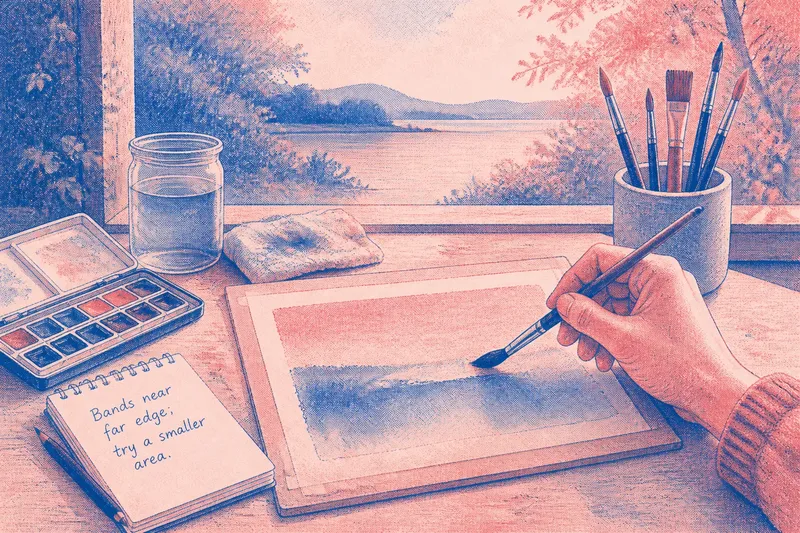
Imagine a watercolor beginner with a small sheet of paper, a round brush, and a wash that keeps drying in visible bands. The painter decides to explore how brush loading affects the wash, wets the brush before starting, and works across the sheet without pausing to refill. The bands still appear near the far edge, so the painter tries a smaller area next time; the resulting decision is to explore brush loading on a manageable space before returning to the full sheet.
A short note can preserve that decision: “Bands near far edge; try a smaller area.” A pocket notebook, phone note, or voice memo all work. If recording the session feels like more effort than the activity, skip it.
Let an observation shape what happens next
A useful observation describes something you could hear, see, or feel, rather than grading your talent. “That was bad” gives you little to work with; “the clay sagged when I pressed near the rim” names a moment you can respond to.
Notes can describe a cue, a condition, or a contrast: “the rhythm loosened at the shift,” “the brush ran dry near the edge,” or “the second sketch gave the shoulders a clearer angle.” You can use that observation to repeat the same approach, change one condition, or return to a broader run-through.
Sometimes the observation is that attention has faded. If attempts are becoming careless, take a break, choose an easier mode, or stop and leave yourself a place to resume.
How should you handle common practice choices?
Does every session need a specific target?
No. Enjoyment, maintenance, and exploration are valid purposes without a narrow target. Use a defined focus when you want to investigate a particular difficulty or change, and let a relaxed session remain relaxed.
What can you do when the same difficulty keeps returning?
Notice where it happens and what comes just before it, then choose one condition to explore. You can work with a smaller section or adjust the surrounding setup rather than repeating the entire activity unchanged.
When should you return to the full activity?
Return when you understand the part well enough to try it in context, even if it is not flawless on its own. The whole activity can show whether your adjustment fits or whether the transition deserves attention.
How much should you record after a session?
Often, a short note about what you explored and what you noticed is enough. If writing interrupts the activity, leave a quick voice memo or skip the record.
Choose repetition or practice again as the activity changes
The difference between repeating a skill and practising it is not the number of attempts. It is the purpose each attempt serves: familiarity, enjoyment, exploration, or focused attention. Let that purpose guide the session rather than treating every repetition as a demand for visible progress.
Next time you return to a familiar skill, choose the kind of experience you want from it. If a fresh question arises, follow it; if the activity is already giving you what you came for, there is no need to turn it into a problem to solve.